Perspectives From a Leader in Sarcoma Research
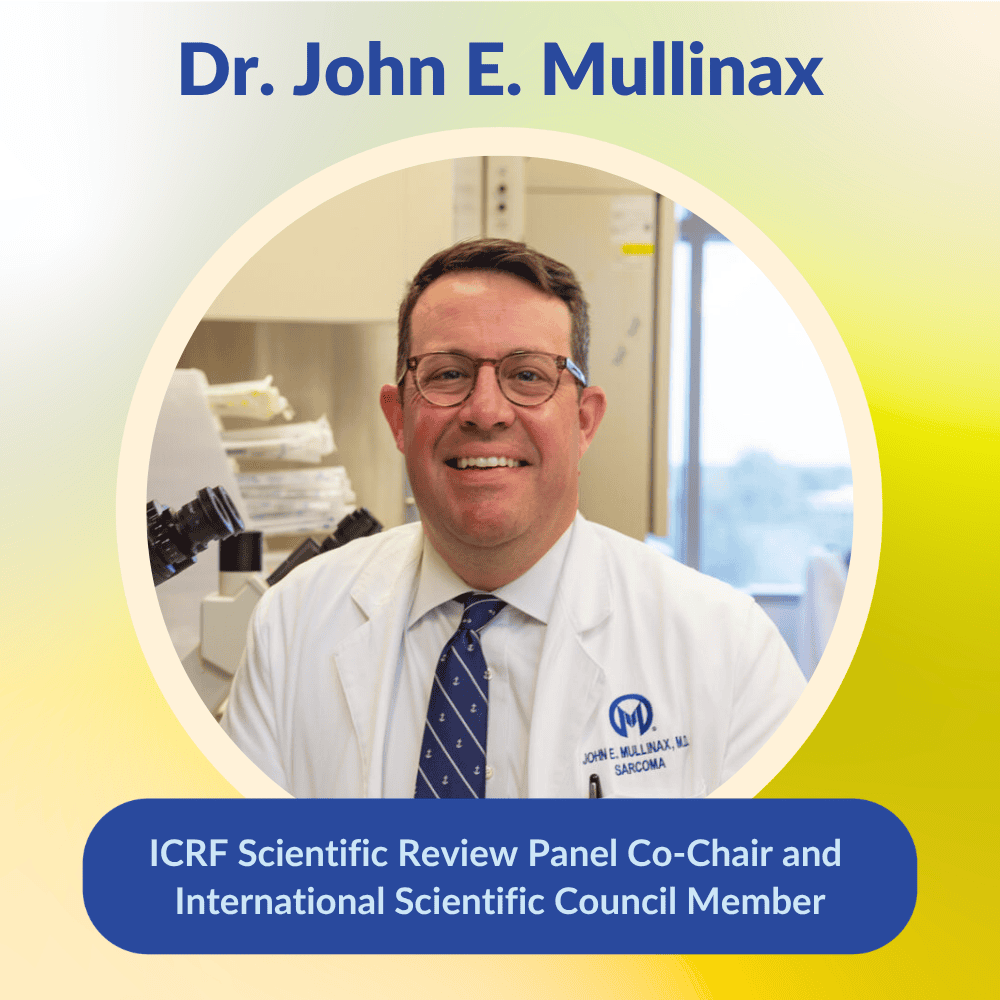
For Sarcoma and Bone Cancer Awareness Month in July, we spoke with John E. Mullinax, MD, FACS, Section Head of Surgical Oncology, Sarcoma Department, and Surgical Director of Cellular Immunotherapy at Moffitt Cancer Center to learn his perspectives. Dr. Mullinax is also Co-Chair of the Clinical Oncology and Therapeutics Panel for ICRF’s Scientific Review Panel and an ICRF International Scientific Council member.
Sarcomas are a rare group of cancers that develop in the bone and soft tissues. While uncommon, they account for a greater proportion of cancers diagnosed in children, adolescents, and young adults than many other cancers, and with more than 70 distinct subtypes, research and treatment can be especially challenging.
Read on to see insights from Dr. Mullinax on recent advances, ongoing challenges, and what gives him hope for the future of sarcoma research.
What has been the most exciting recent breakthrough in sarcoma research?
The biggest breakthrough has been the positive signal we’re seeing with immunotherapy for some subtypes of sarcoma. We have seen FDA approvals of gene-modified T-cell therapy and positive results using immune checkpoint inhibitors with radiation for high-risk primary sarcomas. These findings have focused immune-related research efforts on a few sarcoma subtypes that seem to respond at a higher rate than others.
What remains the biggest challenge?
The term “sarcoma” represents over 70 different malignancies. As a group they are rare and each subtype is exceedingly rare. As we study treatments in the lab, we always struggle with the applicability of results to other subtypes. For clinical trials, we often struggle with accrual due to the rare incidence and difficulty with travel for patients who do not live near a sarcoma program. Finally, industry funding for clinical trials is a foundation of most oncology advances, but the rare nature of sarcoma makes it difficult to attract industry financial support because the ROI is much lower, even for dramatically positive results.
What is the most important thing you want people to know about sarcoma?
The most important thing for patients with sarcoma is to be seen and treated within a high-volume sarcoma program with a multidisciplinary group of experts (medical oncology, radiation oncology, pathology, surgical oncology). Because the incidence of the disease is so rare, many oncologists see only one or two sarcoma patients every five years. For this reason, early referral is critical to ensure the treatment course is appropriate. While it may be a financial burden in terms of travel, there are some fantastic patient advocacy groups that offer patient grants to cover these costs to ensure that high-level care is available to all patients.
What gives you optimism for the future?
I believe sarcoma today is similar to where melanoma was in 2010. As we better understand the biology of different sarcoma subtypes through advanced sequencing and AI-powered analysis, I believe we’ll see improvements in patient outcomes similar to those we’ve witnessed for melanoma over the past 15 years.
Learn About ICRF-Funded Sarcoma Research Advancements
See a recent study published in Oncogene by ICRF-funded researcher Prof. Amir Orian that focuses on a new treatment strategy for sarcomas and other aggressive, drug-resistant cancers.
Learn more about Prof. Amir Orian and his research here.





