

Research & Impact
Research in Israel Drives Progress Toward a Cancer-Free World
ICRF funds innovative cancer research in Israel that advances the understanding, diagnosis, and treatment of cancer while paving the way toward future breakthroughs and ultimately a cure.
Research We Fund

The People Behind the Science

ICRF funds investigators across Israel’s leading institutions at every stage of their careers, from promising emerging scientists to established research leaders.
View or download a pdf of ICRF research grants newly awarded in 2025
Where Discoveries Happen
ICRF proudly supports a diverse portfolio of research grants across 13 leading academic and medical institutions in Israel.






Partnerships
ICRF collaborates with many renowned organizations to support innovative cancer research projects in Israel.
Grant Categories
ICRF awards competitive grants to researchers at all stages, from early-career investigators to established scientific leaders. Learn more about the grant categories below.

Research Professorship Grants
$500,000
over a 5-year period awarded to the researcher.
Awarded to accomplished investigators whose research has significant impact on our understanding of cancer, and whose extended commitment to fundamental issues in cancer are an inspiration to others. Receipt of a Research Professorship is ICRF’s highest honor.

Project Grants
$180,000
over a 3-year period awarded to the researcher.
Designed to support projects of high scientific merit and clear potential significance for advancing the understanding, prevention, diagnosis or treatment of cancer conducted by established, independent investigators.

Career Development Awards (CDAs)
$135,000
over a 3-year period awarded to the researcher.
Mentored awards designed to enhance the research capabilities of early-career scientists who have demonstrated outstanding potential for contribution to cancer research as independent investigators.

Special Initiatives/Projects
A donor or partner-funded initiative in a specific area of study.

“The ICRF CDA has been a pivotal stepping stone in my scientific journey. This support has not only provided the funding needed to push the boundaries of early breast cancer detection but has also given me the confidence and credibility to pursue ambitious research questions.”
Dr. Debbie Anaby
ICRF-Supported Scientist Focused on AI and Early Breast Cancer Detection.
Moving Research Forward
A main output of research is new knowledge, and ICRF-funded researchers regularly share their discoveries widely to have the greatest impact. They often publish in peer-reviewed renowned scientific journals and share their findings at global conferences, affirming ICRF’s leadership in worldwide cancer research.

Real-World Impact
Over the past five decades, ICRF-supported scientists have helped shape many of the most transformative fields in modern oncology, including:
-
Targeted therapy
-
Proteasome inhibition
-
Tumor suppressor biology
-
Epigenetics
-
Nanomedicine
-
Bone marrow transplantation
-
DNA repair therapeutics
-
Precision oncology
-
Liquid biopsy technology
-
Immunotherapy
These milestones are a few of many that reflect the real-world impact of this research.
Revolutionizing Cancer Treatment

Velcade®
A drug used to treat multiple myeloma, a cancer of the bone marrow, was developed based on the research of ICRF Research Professorship Grant Recipients and Nobel Laureates Drs. Avram Hershko and Aaron Ciechanover of the Technion – Israel Institute of Technology, whose pioneering discoveries uncovered the ubiquitin-mediated protein degradation system and laid the foundation for proteasome inhibitor therapies such as Velcade.
Prior to this, there were no effective treatment options. Today, this drug, along with newer treatments based on the same research, are the standard of care used worldwide, while the median survival for patients of this once fatal disease has nearly quadrupled.
Gleevec®
The first precision targeted cancer therapy was developed based on the research of ICRF grantee Eli Canaani of the Weizmann Institute of Science.
Gleevec revolutionized treatment for chronic myeloid leukemia (CML) by specifically attacking cancer-causing cells while sparing healthy ones. The drug transformed CML from a once fatal disease into a manageable condition. Time magazine famously dubbed it a “bullet” against this devastating cancer.
Doxil®
The first liposomal drug delivery therapy designed to deliver chemotherapy directly to tumors was developed by ICRF grantee Dr. Alberto Gabizon of Shaare Zedek Medical Center.
Doxil® used liposomes — microscopic fat bubbles and an early nanoparticle drug delivery system — to help chemotherapy circulate longer in the body while reducing toxic side effects. It became the first liposomal drug approved to treat a solid tumor and remains an important treatment for ovarian cancer, AIDS-related Kaposi’s sarcoma, and several other cancers.
Foundations of Cancer Biology
The p53 gene
Originally thought to cause cancer, after additional research it was discovered that the p53 gene, in an unmutated form, was actually a tumor suppressor. Its role in the majority of human cancers was further clarified by ICRF grantees Drs. Moshe Oren and Varda Rotter of the Weizmann Institute of Science.
This gene is often referred to as the “guardian of the genome” due to its role in regulating DNA repair and cell division. It suppresses tumors by either repairing damaged DNA or triggering the death of cells where the DNA is too damaged to be repaired.
DNA methylation
DNA methylation is a key epigenetic process that turns genes on and off and acts as a guide for reproducing cells by indicating which parts of the DNA should be used and which should not.
Pioneering work in this area was conducted by ICRF Research Professorship grantee and Israel Prize winner, Dr. Howard Cedar of the Hebrew University-Hadassah Medical School.
Genetics and Cancer Risk
RAD51 and BRCA Pathway
The discovery that a minor mutation in this gene increases the risk of breast cancer in women with the BRCA2 gene mutation was made by ICRF grantee Dr. Ephrat Levy-Lahad of the Shaare Zedek Medical Center.
Advancing Cancer Treatment Techniques
Novel Bone Marrow Transplantation
ICRF grantee Dr. Yair Reisner of the Weizmann Institute of Science helped develop innovative bone marrow transplant approaches that greatly expanded the donor pool for leukemia patients. His work helped make transplants possible for more patients who previously lacked compatible donors.
Stem Cell Migration Mechanisms
Building on advances in stem cell research, ICRF grantee Dr. Tsvee Lapidot and his team uncovered key mechanisms that guide stem cell migration from the bloodstream to the bone marrow, helping improve the success and effectiveness of bone marrow transplantation.
Next-Generation Cancer Research
RNA Editing and Immunotherapy (ADAR1 Mechanism)
Research by ICRF-supported scientists Prof. Erez Levanon and Prof. Eli Eisenberg advanced understanding of ADAR-mediated RNA editing, opening new avenues in cancer immunotherapy research.
3D Living Tumor Models
ICRF-supported scientist Prof. Ronit Satchi-Fainaro of Tel Aviv University pioneered advanced 3D living tumor models that recreate the complexity of human cancers. Using patient-derived cells and bioprinting technologies, her research is helping scientists better study tumor behavior, test potential therapies, and advance more personalized cancer treatment approaches.
Awards and Recognition
For more than 50 years, ICRF has supported many of Israel’s brightest scientific minds. Past and current ICRF-funded researchers continue to receive prestigious awards and international recognition for their contributions to advancing cancer research and biomedical innovation.
-
Nobel Prize
-
Israel Prize
-
Wolf Prize
-
Landau Prize
-
Lasker Award
-
Breakthrough Prize in Life Sciences
-
Nature’s 10 for Shaping Science
-
The AACR Scientific Achievement Award
-
Time Magazine Best Innovations
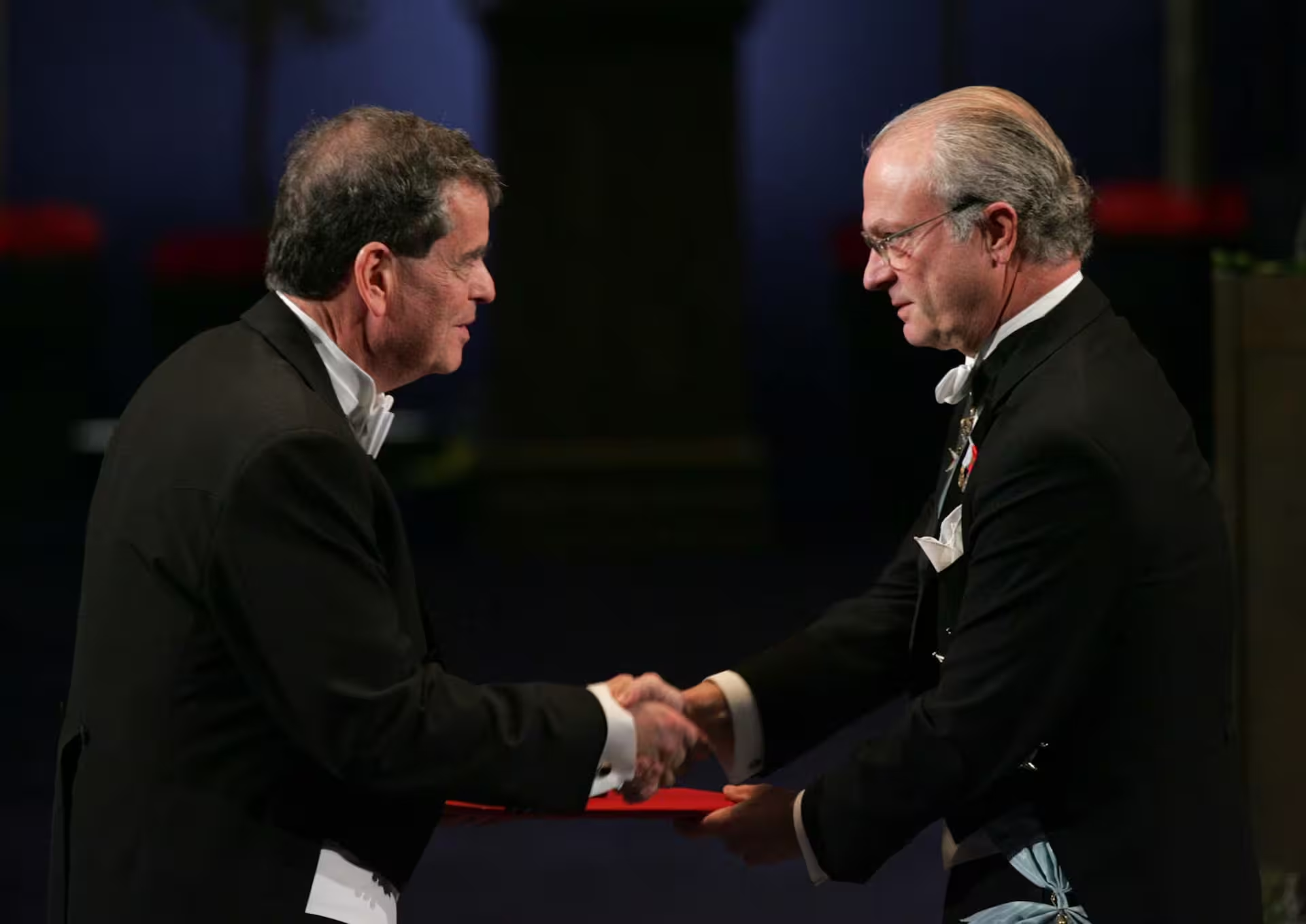
“There is no doubt I owe much of my success and the international recognition and accolades I have received to the generous support of ICRF and its amazing supporters, a debt I feel I shall never be able to repay.”
Professor Aaron Ciechanover
ICRF Supported Scientist and 2004 Nobel Laureate.
Tomorrow Begins Today
Milestones in cancer research are happening now. See some of the recent discoveries driven by ICRF-funded grantees.
