Ashkenazi Jewish Ancestry and Breast Cancer: What BRCA Research in Israel Is Revealing
About 1 in 50 people of Ashkenazi Jewish descent carries a harmful change in the BRCA1 or BRCA2 gene, roughly eight times the rate in the general population (about 1 in 400). These inherited changes sharply raise the lifetime risk of breast and ovarian cancer, and to a lesser degree the risk of pancreatic and prostate cancer.
This Breast Cancer Awareness Month, we look at why BRCA mutations are more common in Ashkenazi Jewish families, what they mean for women and men who carry them, and how scientists funded by Israel Cancer Research Fund (ICRF) are working to turn genetic risk into earlier detection, better prevention, and more personal care.
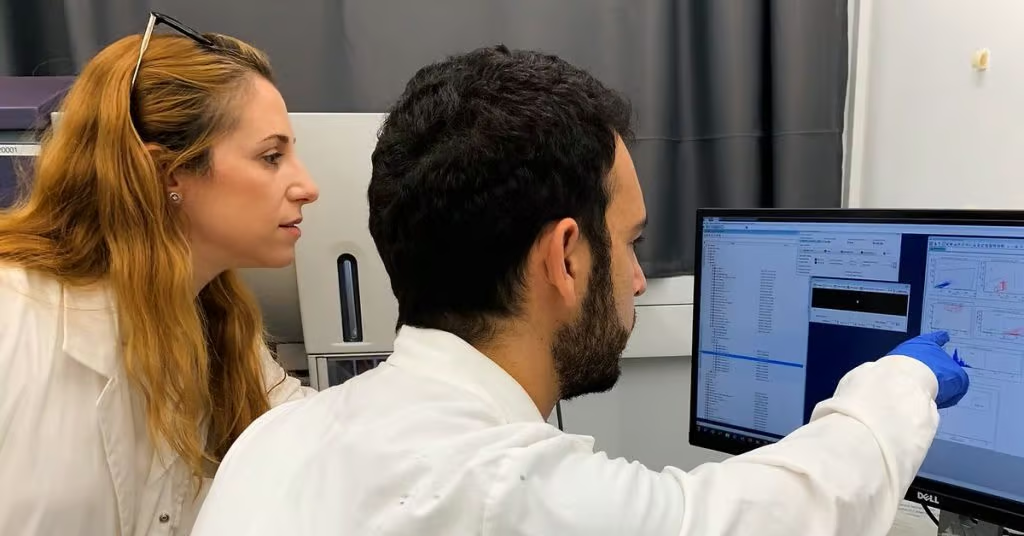
ICRF-Funded Researcher Dr. Merav Cohen with a colleague at her lab at Tel Aviv University. Photo Credit: Merav Cohen Lab
Why is breast cancer risk higher in Ashkenazi Jewish families?
The answer lies in what geneticists call a founder effect. Today’s Ashkenazi Jewish population descends from a relatively small group of ancestors. A few gene changes that happened to be present in that group were passed down and became more common over many generations.
For BRCA, three specific changes account for most harmful mutations in Ashkenazi Jewish families: two in BRCA1 (known as 185delAG and 5382insC) and one in BRCA2 (6174delT). Because the same three mutations appear again and again, they have been studied in unusual depth, and Israel is one of the best places in the world to do that work. With one of the largest Ashkenazi Jewish populations anywhere, Israeli researchers have a rare opportunity to study genetics, risk, prevention, and treatment in ways that help patients around the world.
Carrying one of these mutations does not mean a person will develop cancer, and most people of Ashkenazi Jewish descent do not carry one. But for those who do, knowing their status can open the door to closer screening and informed choices.
BRCA1 and BRCA2: what these genes do
Everyone has two copies of the BRCA1 and BRCA2 genes, one inherited from each parent. Their job is to make proteins that help repair damaged DNA, which makes them part of the body’s natural defense against cancer. A person who inherits a harmful change in one copy still has a working backup. But if that backup copy is damaged in a cell later in life, the cell loses an important way of fixing DNA. Over time, errors can build up in that cell and lead to cancer.
How much does a BRCA mutation change the odds? According to the National Cancer Institute, about 13% of women in the general population will develop breast cancer during their lifetime. Among women who inherit a harmful BRCA1 or BRCA2 change, more than 60% will. The difference is even sharper for ovarian cancer: about 1.1% of women overall, compared with 39%–58% of BRCA1 carriers and 13%–29% of BRCA2 carriers.
ICRF-funded scientists have been part of this story for decades, including pioneering work on BRCA and on RAD51, a gene that works hand in hand with BRCA2 to repair DNA.
More than breast cancer: ovarian, pancreatic and prostate risk
BRCA mutations are best known for breast and ovarian cancer, but they affect other organs too. The National Cancer Institute estimates that up to 5% of people with a harmful BRCA1 change and 5%–10% of those with a harmful BRCA2 change will develop pancreatic cancer. For men, the risk of prostate cancer by age 80 is about 7%–26% with BRCA1 and 19%–61% with BRCA2.
Pancreatic cancer is one of the hardest cancers to treat, and BRCA-related pancreatic cancer is a major focus for ICRF researcher Dr. Talia Golan and her team. We will look at that work in depth in our Pancreatic Cancer Awareness Month article.
Why don’t all BRCA1 carriers develop breast cancer?
One of the most striking facts about BRCA1 is how differently it plays out from one woman to the next. Some carriers are diagnosed with breast cancer before age 35; others remain cancer-free past 60. That variation suggests other factors, genetic and non-genetic, raise or lower each woman’s risk. Today, carriers face difficult decisions, from intensive screening starting at a young age to surgery to remove the breasts and ovaries, choices that are irreversible and carry real side effects.
Prof. Ran Elkon of Tel Aviv University is working to change that. With an ICRF Project Grant (2025–2028), his team is recruiting a large group of Israeli Ashkenazi Jewish women who carry a BRCA1 mutation and sequencing their entire genomes. The goal is to discover the genetic variants that modify breast cancer risk, combine them with known non-genetic risk factors, and use advanced computational methods to build a more precise risk model for each carrier. As Prof. Elkon’s project notes, this matters especially in Israel, because Ashkenazi Jews have among the highest prevalence of BRCA1 carriers of any population in the world.
Catching breast cancer before it starts
What happens in breast tissue before cancer appears? Dr. Merav Cohen, head of the Systems Immunology & ImmunoGenomics Laboratory at Tel Aviv University, studies how immune cells and breast cells communicate as the breast develops, and how that conversation changes in tissue that will later become cancerous.
In her current ICRF project (2025–2028, funded in partnership with the Redhill Foundation), Dr. Cohen’s lab uses advanced single-cell sequencing technologies to build a map of these cell-to-cell interactions. Her team will check its findings in tumor samples from patients with very early (in situ) breast cancer and from patients with BRCA1 and BRCA2 mutations. The aim: new biomarkers for early detection and new targets for immunotherapy that could act before cancer takes hold.
How AI is helping read breast cancer biopsies
Prof. Ron Kimmel of the Technion, Israel Institute of Technology, brings computer vision and machine learning to the pathology lab. His team recently published an AI tool to predict chemotherapy benefit. With an ICRF Project Grant (2024–2027), he is testing a deep-learning system that analyzes digitally scanned biopsy slides to make breast cancer subtyping more consistent and accurate, helping doctors tailor treatment to each patient. Because the system needs only a digital scanner and an internet connection, it could bring advanced analysis to clinics with limited resources anywhere in the world.
AI is just one of the new tools Israeli scientists are applying to breast cancer. Dr. Albert Grinshpun of Shaare Zedek Medical Center, for example, is using a simple blood test, known as a liquid biopsy, to monitor how patients respond to treatment. He discussed that work in a recent ICRF and Sharsheret webinar.
Genetic testing and Ashkenazi Jewish ancestry: where to start
If you have Ashkenazi Jewish ancestry, or a family history of breast, ovarian, pancreatic or prostate cancer, it may be worth asking your doctor or a genetic counselor whether BRCA testing is right for you. A genetic counselor can explain what testing involves, what a positive or negative result would mean, and what it could mean for your relatives, before you decide.
Frequently asked questions
Ashkenazi Jewish women are more likely to carry an inherited BRCA1 or BRCA2 mutation: about 1 in 50, compared with about 1 in 400 in the general population. Most Ashkenazi Jewish women do not carry a mutation, but those who do have a much higher lifetime risk of breast and ovarian cancer.
Two are in BRCA1 (185delAG and 5382insC) and one is in BRCA2 (6174delT). Together they account for most harmful BRCA changes found in Ashkenazi Jewish families.
Yes. Men can inherit a BRCA mutation and pass it on to their children. Carriers also have a higher risk of prostate, pancreatic and male breast cancer.
ICRF-funded scientists in Israel contributed pioneering work on BRCA and the DNA-repair gene RAD51. Today ICRF funds projects such as Prof. Ran Elkon’s search for genetic factors that modify breast cancer risk in BRCA1 carriers.
Since 1975, ICRF has invested just under $109 million in more than 3,000 research grants to scientists in Israel. Every project is selected through a rigorous peer review modeled on the National Institutes of Health, and every grant is made possible by people who believe that research is the answer to cancer.
How donors make this research possible
Since 1975, ICRF has invested just under $109 million in more than 3,000 research grants to scientists in Israel. Every project is selected through a rigorous peer review modeled on the National Institutes of Health, and every grant is made possible by people who believe that research is the answer to cancer.
Support research for breast cancer and all cancers
Your gift helps Israeli scientists turn discoveries like these into earlier detection and better treatment for patients everywhere.
Related articles
- Science Made Simple: Dr. Julie Lang on the Future of Breast Cancer Research and Care
- In the News: ICRF Scientists Use AI to Transform Israel’s Cancer Research
- In the News: ICRF-Funded Grantee Featured for Nanoparticle Research
This article is for general information only and is not medical advice. Please speak with your doctor or a genetic counselor about your personal risk.